Word rules: what counts as a valid word
Plain rules for what you can play, why, and the few places WordSalvo bends the strict tournament line on purpose.
Last updated May 27, 2026 · By WordSalvo
Play WordSalvo against real players
Every word is a real word
WordSalvo validates every move against a curated word list built from the authoritative lexicon for that language — Collins/ABSP for English, OpenTaal and the NTSV Taalreglement for Dutch, the ODS for French, the official Mattel list for Italian, and the equivalent recognised source for every other language. If a word is not in that list, it cannot be played, no matter how plausible it looks.
This is the same principle as a tournament dictionary: the list is the referee. It removes arguments mid-game and means a word that scores is a word both players can look up afterwards.
No abbreviations, no chat-speak
WordSalvo does not accept abbreviations, initialisms, acronyms, or invented chat-speak as words. Things like <em>FYI</em>, <em>LOL</em>, or a brand’s initials are not playable. The only short letter-pairs that are valid are the ones that appear as real entries in the language’s official word list.
We periodically sweep the lists to strip non-words that slipped in from bulk imports. Where a short form has genuinely entered the dictionary as a headword in its own right, it stays — but the bar is the official list, not how common the abbreviation is in everyday texting.
The two-letter words
Two-letter words are the most valuable thing to memorise in any word game: they let you hook onto existing words, open up tight boards, and play parallel plays for big scores. Each language has its own set, and they are not interchangeable — <em>QI</em> is good in English, useless in French.
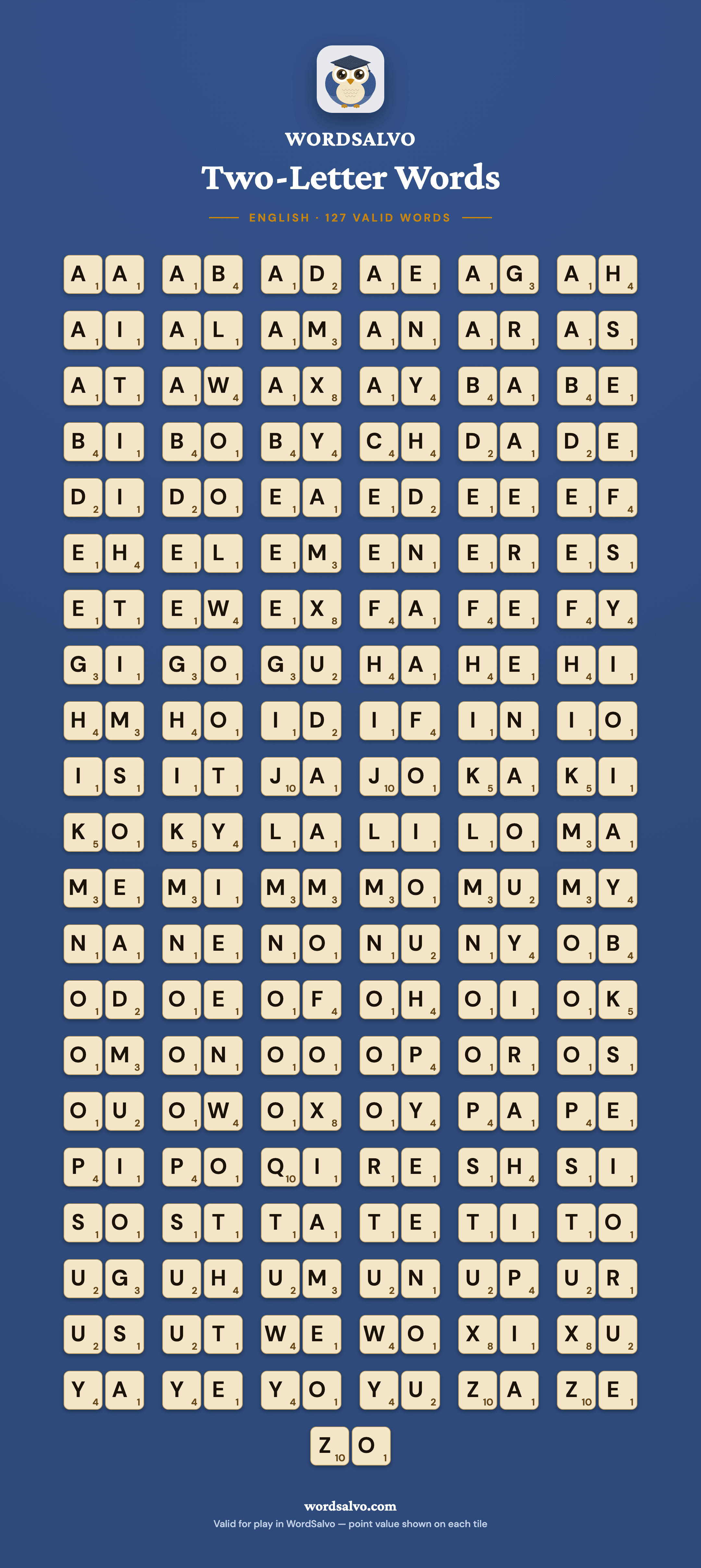
Here is the complete, current list of valid two-letter words in English (<strong>127</strong> words), with each tile’s point value shown. Save it, screenshot it, study it.
Nationalities and demonyms are allowed
Here WordSalvo deliberately differs from strict tournament rules. Tournament dictionaries exclude proper nouns and their derivatives, which technically rules out everyday nationality words. WordSalvo <strong>allows common demonyms</strong> — the ordinary word for a person from a country, region, or city — in every language. So <em>dane</em>, <em>finn</em>, <em>arab</em>, <em>briton</em>, <em>croat</em> are all playable in English, and the equivalents are allowed in every other language.
Why: WordSalvo is a game people play to relax, not a tournament engine. Players overwhelmingly expect to be able to play the everyday word for a nationality, and rejecting them is the single most common "the dictionary is broken" complaint. The narrow line — demonyms yes, personal and brand names no — keeps obvious words playable without re-admitting genuine proper nouns.
What is still excluded
The demonym relaxation is narrow on purpose. These remain invalid in every language:
- Personal and given names and surnames — <em>smith</em>, <em>kelly</em>, <em>rembrandt</em>.
- Brand and organisation names — <em>lego</em>, company initials.
- Pure place names and toponyms — <em>milan</em>, <em>rio</em>.
- Abbreviations, initialisms, and acronyms that are not dictionary headwords.
- Foreign-language leakage, misspellings, and malformed or invented forms.
A few other house rules
WordSalvo is its own game, not a clone, so a couple of mechanics differ from what you may expect: the board uses a custom premium-square layout, the bag holds <strong>104 tiles</strong> (100 in Danish), and playing all seven tiles in one turn earns a <strong>45-point</strong> bonus. None of that changes which <em>words</em> are valid — the word list is the same authoritative list described above, in all 15 supported languages.
Frequently asked questions
- Why was my word rejected when it is clearly a real word?
- It is not in the official word list for that language. WordSalvo follows the authoritative lexicon (Collins/ABSP, OpenTaal/NTSV, ODS, and so on), and only words in that list are playable. If you believe a genuine word is missing, you can suggest it in the app — additions are reviewed against authoritative sources.
- Are abbreviations like TV or CD valid?
- Only if they appear as a real headword in that language’s official word list. WordSalvo does not add abbreviations or initialisms on its own, and periodically removes non-words that slipped in from bulk imports.
- Can I play nationalities like "dane" or "turk"?
- Yes. WordSalvo deliberately allows common demonyms — the everyday word for a person from a place — in every language, even though strict tournament rules exclude them. Personal names, brand names, and pure place names remain excluded.
- Do the two-letter words differ by language?
- Yes, completely. Each language has its own set of valid two-letter words drawn from its own dictionary. The list above is English only; see the equivalent list on this page in each language.