A Wordfeud alternative, for players who want more depth
For Wordfeud players curious what another decade of competitive layers looks like bolted onto the same board.
Last updated April 17, 2026 · By Kurt Bijl
Play WordSalvo against real players

Scoring is almost the same — except bingos
Wordfeud and WordSalvo both run a 15×15 board, a seven-tile rack, Double Letter / Triple Letter / Double Word / Triple Word premiums, stacking word multipliers, and a single center square you must cover on the opening move. If you already play Wordfeud, the muscle memory transfers immediately.
The headline difference is the bingo bonus. Wordfeud's official help page spells it out: "If a player uses all seven tiles he is awarded an additional 40 points" (Wordfeud Help). WordSalvo's bingo is +45, sitting between Wordfeud's 40 and Scrabble's 50. Five points per bingo compounds: across a 3-bingo game that's 15 points of ceiling, enough to flip a close match without letting a single rack-clear decide it.
Swapping rules match too — you can swap any number of tiles but only while the bag still holds at least seven (Wordfeud Help, mirrored in WordSalvo). Blanks are worth zero in both games. If you like Wordfeud's rulebook, you already like 95% of WordSalvo's.
Both ship a random-board mode
Wordfeud's Play Store listing calls it out: "You can choose the option to randomize the board and change up where the DL, TL, DW, TW tiles are placed" (Google Play — Wordfeud). WordSalvo offers the same toggle, plus a constraint set — identical premium counts, diagonal symmetry, no two premiums touching — so randomized boards stay playable instead of drifting into freak layouts.
For Wordfeud players who already prefer Random over Normal, WordSalvo's equivalent will feel familiar. Leaderboards and stats are tracked per language and per board layout, so a Random-board rating sits separately from a Classic-board rating — your PRs on one do not leak into the other.
Ratings and matchmaking: Wordfeud has one, but does not use it
Wordfeud does track a Performance Rating — community docs describe it as ELO-based. What it does not do is match you by it. The Feudia FAQ puts it plainly: "There is no skill tracking, so you may end up paired with an opponent who is significantly more or less skilled than you are" (Feudia — Wordfeud FAQ). Random Opponent in Wordfeud pairs on board + dictionary, full stop.
WordSalvo runs Glicko-2 — the successor to ELO used by chess federations — and matches online games inside a ±200 rating-point window. Everyone starts at 1500. A loss to a stronger opponent costs far less than a loss to a weaker one, and rating uncertainty tightens the more you play.
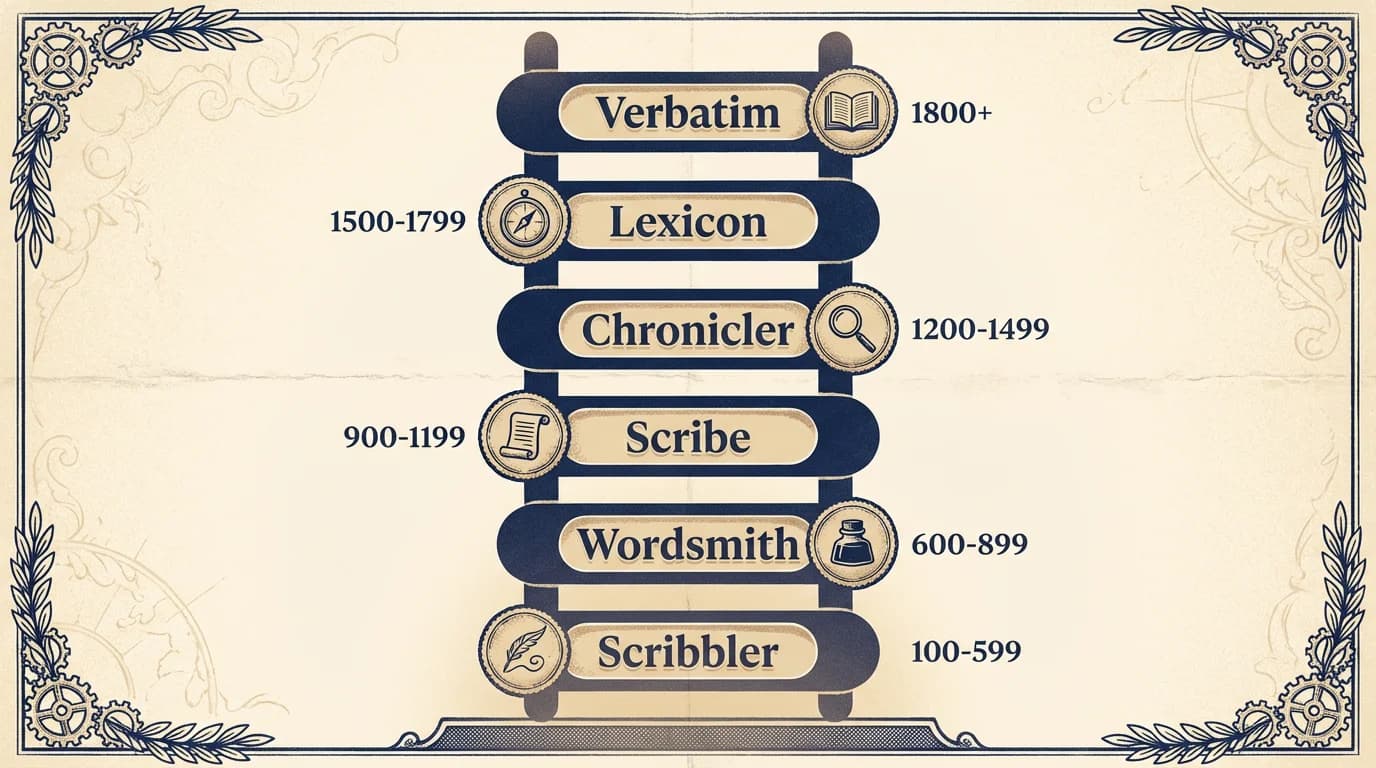
Above the number sits a named tier ladder: Novice (0–1149), Apprentice, Scholar, Adept, Virtuoso, Savant, Maestro, Sage, Grandmaster, Laureate (2300+). Ten rungs, one per language × board combination. Wordfeud's official help docs list no comparable named rating ladder as of April 2026.
Post-game analysis: the feature Wordfeud does not ship
This is the widest gap. Wordfeud ends a game on a final score screen; Wordfeud's help documentation lists no post-game engine review, no optimal-move suggestions, no brilliancy scoring, and no move-by-move replay against a solver.
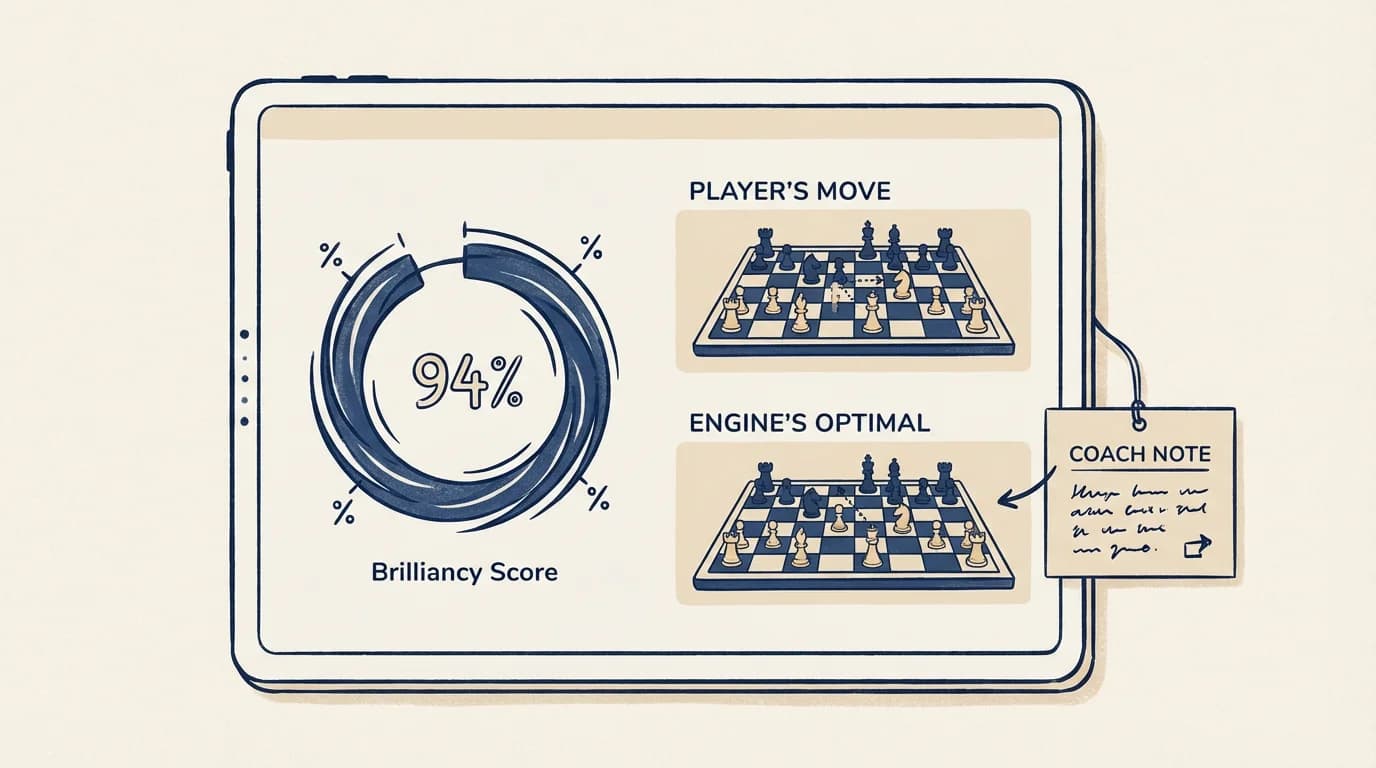
WordSalvo runs two analysis passes on every completed game. The first is a client-side instant pass — under a millisecond — that flags the decisive moment, the rack penalty, and any personal records you just set. The second is a server-side pass in a Cloud Function: it replays the whole game, scores each of your moves against the engine's best, and surfaces a Brilliancy Score (share of optimal points you captured), optimal moves you missed, and turning points where the game tilted.
You can open the Analysis screen to step through analyzed moves, see the engine's alternative, and read a coach note. Instant stats are free; the full engine replay sits on the Word Master plan. Full detail at Post-game analysis.
Ratings, tournaments, rivalries
WordSalvo adds rated play, tournament structure, and head-to-head history around the same board-game rhythm. The exact competitive surfaces should be judged from the current app build, not from speculative roadmap language.
Wordfeud's competitive loop stops at the Performance Rating number and a friends list. Its Play Store listing advertises up to 30 simultaneous games, which is real and great for asynchronous play.
Languages: broad Wordfeud coverage, focused WordSalvo launch
Wordfeud ships dictionaries for 10 languages: English, German, Spanish, Portuguese, French, Dutch, Norwegian, Swedish, Danish, and Finnish (Wordfeud Help). That roster is strong and well-maintained — the OpenTaal Dutch list, for instance, is a respected independent authority.
WordSalvo goes live with English and Dutch first. Each go-live language carries its own letter distribution, tile values, and dictionary.
| Wordfeud | WordSalvo | |
|---|---|---|
| Board | 15×15 | 15×15 |
| Rack | 7 tiles | 7 tiles |
| Bingo bonus | 40 | 45 |
| Random-board mode | Yes | Yes |
| Languages | 10 | English and Dutch at go-live |
| Rating | ELO-style Performance Rating | Glicko-2 |
| Skill-based matchmaking | No (source) | ±200-point window |
| Named tiers | None | Novice → Laureate |
| Post-game engine analysis | None (source) | Brilliancy + optimal moves |
| Tournament play | None documented | Yes |
| Fair-play system | Not documented | Baseline checks + suspicious-pattern flags |
| Free tier | Yes, with ads | Yes, with ads |
| Remove ads | Paid app (Wordfeud Premium) | One-time purchase or Word Master |
Price, ads, and fair play
Both games are free with ads. Wordfeud sells a paid app, Wordfeud Premium, to strip ads. WordSalvo offers a one-time Ad-Free purchase for the same purpose, plus an optional Word Master subscription that unlocks the engine analysis, unlimited daily-puzzle retries, and cosmetic themes. Nothing that affects whether you win or lose is paywalled.
On the cheating question: WordSalvo checks completed PvP games for suspicious patterns using per-move analysis and per-player baseline comparisons in a Cloud Function. Wordfeud's public help does not document an equivalent, though players can report opponents. See Fair play for how it works.
Who should stay on Wordfeud
If your ideal word game is 30 async games running in parallel with friends you already have on Wordfeud, and you have zero interest in ratings, analysis, or tournaments — Wordfeud is a better fit. 40 million downloads (Wikipedia — Wordfeud) means your opponents are already there.
If you want a rating that actually gates your matches, a move-by-move engine replay after games, tournament play, and English/Dutch go-live support — WordSalvo. You do not have to choose; they coexist fine on one phone.
Frequently asked questions
- is wordfeud still active in 2026?
- Yes. Bertheussen IT is still publishing updates (the Play Store listing reports a March 2026 release) and the game crossed 40 million downloads in August 2025. It is a healthy, actively maintained product — the reason to try WordSalvo is additive features, not Wordfeud decline.
- can I import my wordfeud games or rating?
- No. Wordfeud games live in Bertheussen IT's servers and are not exportable. WordSalvo ratings start at 1500 and calibrate over your first 10–20 rated games via Glicko-2, so the ladder finds your level quickly without an import.
- which is more popular, wordfeud or wordsalvo?
- Wordfeud. 40 million downloads since 2010, strong in the Nordics and the Netherlands. WordSalvo is a 2026 indie release — smaller audience, more recent feature set. If raw opponent volume is your priority, Wordfeud wins today.
- is the wordfeud bingo bonus really 40?
- Yes, per Wordfeud's own help page. Scrabble uses 50, Wordfeud uses 40, WordSalvo uses 45. The +5 over Wordfeud shows up as roughly 10–15 extra points across a typical game with two or three bingos.
- does wordfeud have post-game analysis?
- Not as of April 2026. Wordfeud's help documentation lists no engine replay, brilliancy score, or optimal-move highlighting. The app ends with a final score and your Performance Rating update. WordSalvo runs client-side instant analysis on completed games, and covered rated games can receive a server-side engine replay.
- are wordfeud and wordsalvo dictionaries the same?
- Overlap, not identity. Both draw from respected national wordlists per language (OpenTaal for Dutch, SOWPODS-lineage for English). Edge cases can differ — a word accepted on one may be rejected on the other. WordSalvo has its own launch dictionary set; overlap is not identity, so edge cases can differ even when both apps support the same language.