How WordSalvo works
A walkthrough of one match, from the opening tile across the center to the analysis reveal.
Last updated April 17, 2026 · By Kurt Bijl
Play WordSalvo against real players
Install the app and pick a language
WordSalvo is a cross-platform Flutter app. It goes live with English and Dutch dictionaries first, and you pick the dictionary per game, not at install.
Each language carries its own native wordlist, compiled to a DAWG (Directed Acyclic Word Graph) for O(m) lookup during play. English draws from lists in the lineage of SOWPODS; Dutch uses the OpenTaal wordlist. Your language choice also sets the letter distribution, tile values, and total tile count for the bag.
Start a game — local, online, or AI
Three match types ship today. Local pass-and-play hands a single device between two to four players. Online multiplayer uses Firestore for turn-by-turn move submission and state streaming. AI opponents run at easy, medium, hard, or expert difficulty in a Cloud Function, so the bot takes its turn on the server, not your phone.
Online matchmaking is queue-based. When a match is found, WordSalvo does not drop you into the board — it surfaces the game as a lobby card so you choose when to enter. Friend invites and challenge links land in the same lobby.
Read the board
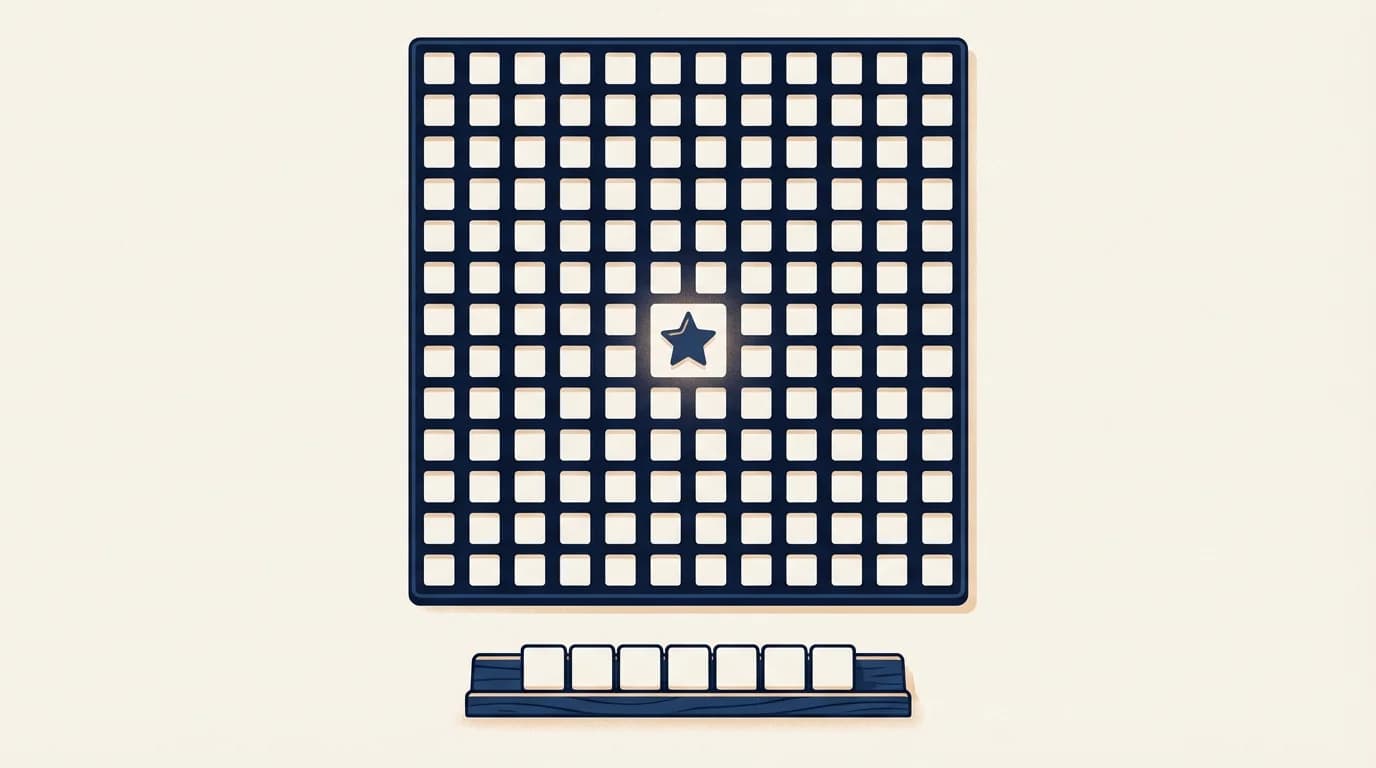
Every game is played on a 15×15 grid with one center square you must cover on the opening move. Two layouts are available: a fixed premium pattern custom to WordSalvo (not the Scrabble board), and a random board mode that re-rolls multiplier placement each game while keeping the same premium counts, diagonal symmetry, and no-adjacent-premiums rule.
Both layouts use the same premium totals: 8× Triple Word, 16× Double Word, 12× Triple Letter, 24× Double Letter, plus the center star. The center square is a placement requirement, not a scoring bonus — covering it on move one does not double your word.
Draw your rack of seven tiles
At the start of the game you draw 7 tiles from the bag. After every move the bag refills your rack back to seven until it runs dry. Total tile count varies by language: English uses 104 tiles, and the English and Dutch go-live dictionaries each have their own letter distribution tuned to their letter frequencies.
Two tiles in every bag are blanks. A blank can stand in for any letter, but it is always worth zero points — no matter which letter it represents, no matter which square it lands on. This is the biggest gotcha for players arriving from Scrabble or Wordfeud; the scoring step below spells out the math.
Place your first word across the center
Long-press a tile in your rack and drag it onto the board. The opening move must cover the center square and form a word of two or more tiles. Every later move must connect to an existing tile, sit on a single row or column, leave no gaps, and produce only real words — including every cross-word it creates.
Tiles you drop are tentative: they show a live word-and-score preview before you commit. If the placement is illegal or the word isn’t in the language’s dictionary, the submit button stays disabled and you can drag the tiles back to your rack without penalty.
Score the move
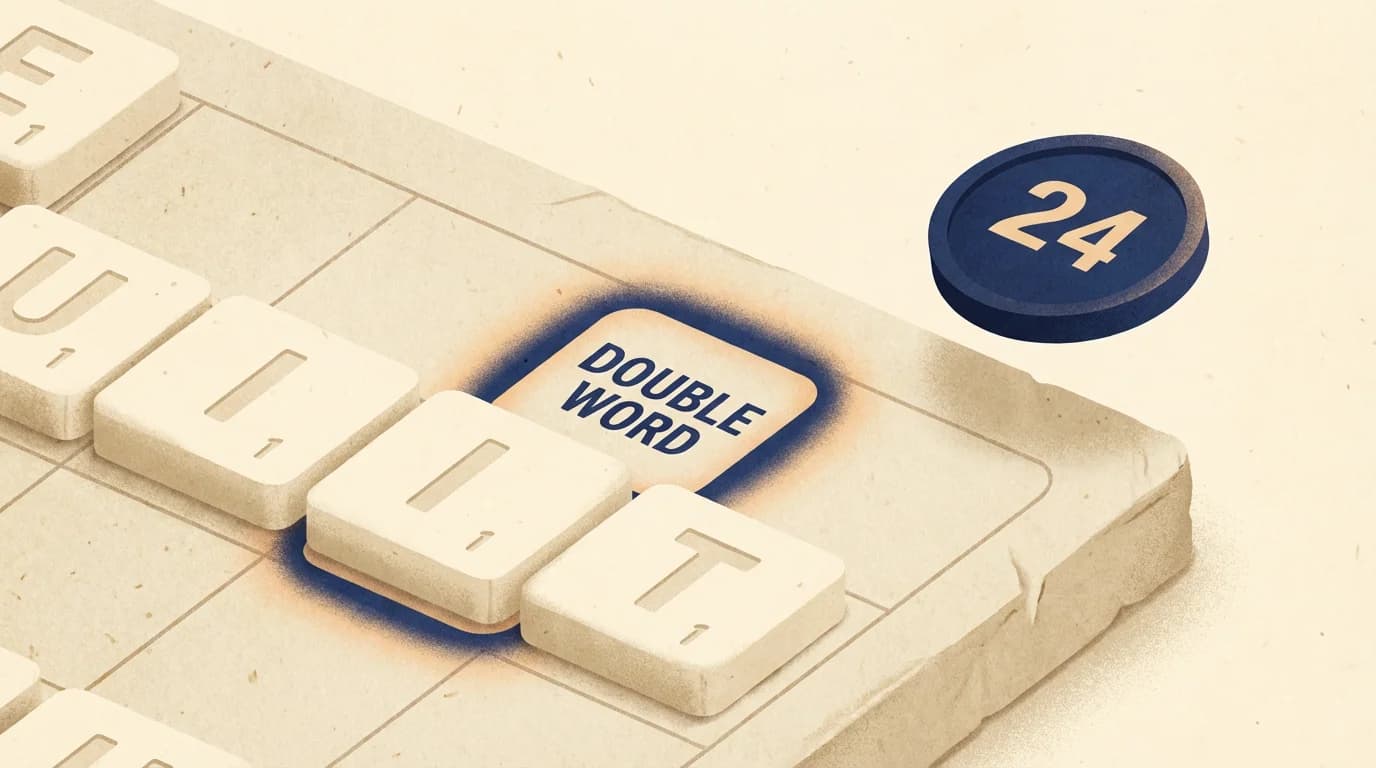
Scoring only counts newly placed tiles against premium squares. Double and Triple Letter squares double or triple that tile’s value. Double and Triple Word squares multiply the whole word, and word multipliers stack inside a single move: two Double Words = 4×, a Double Word crossing a Triple Word = 6×, two Triple Words = 9×.
Tiles already on the board from a previous turn no longer trigger their square’s multiplier — premiums are one-shot. Blank tiles score zero even when they sit on a Double or Triple Letter square; the word multiplier on that square still applies to the rest of the word, but the blank itself adds nothing to the letter total.
Play a bingo for +45
Playing all seven tiles from your rack in a single turn earns a bingo — a +45 point bonus on top of the word’s base score. That sits between Scrabble’s 50-point bingo and Wordfeud’s 40-point bingo: enough to reward the play without letting a single rack-clear decide the match.
The +45 bonus is the same for English and Dutch at go-live. A bingo that also crosses a Triple Word square can clear 100 points in one move; if it was the best move available, the end-game analysis can flag it as a brilliancy.
Swap, pass, or play on to the end
If your rack is stuck you can swap any number of tiles back into the bag, but only while the bag still holds at least seven tiles. Swapping costs your turn and resets the consecutive-pass counter. You can also pass outright for zero points.
The game ends one of two ways. A play-out: one player empties their rack while the bag is also empty. An all-pass stalemate: every player passes twice in a row (four passes in a two-player game). Rated online games can add a per-move timer — when a time limit is set, running it out ends your turn.
Unplayed tiles matter at the end. On a play-out, the winner gains the sum of every opponent’s remaining rack value and each loser subtracts their own leftover value from their score. On an all-pass ending, every player simply loses their own rack value — nobody collects a bonus.
Read the analysis
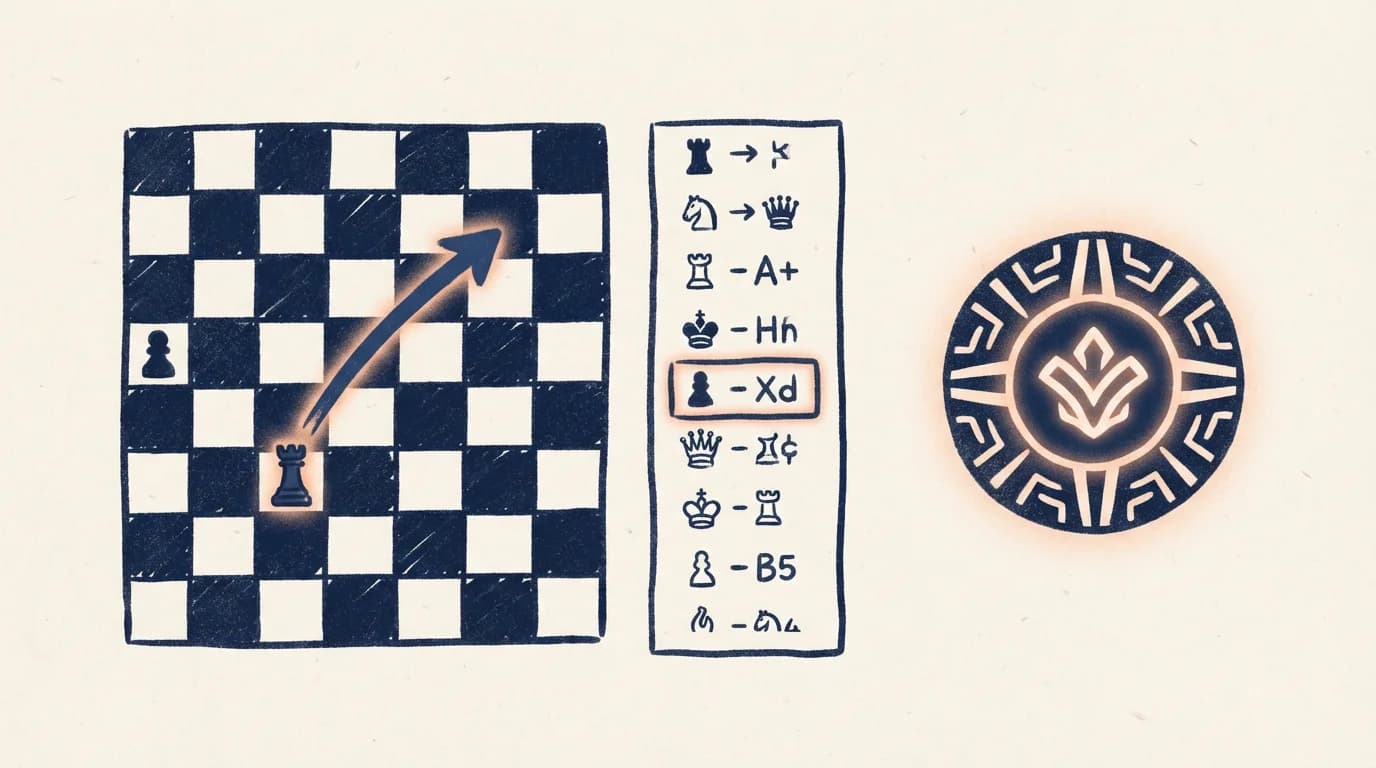
As soon as the final tile is played, WordSalvo computes client-side instant stats in under a millisecond — decisive moment, rack penalty, personal records — and slides them under the final score. A server-side pass follows: a Cloud Function replays the game, scores each of your moves for brilliancy, flags optimal moves you missed, and marks turning points where the game tilted.
Open the Analysis screen to step through the board state move by move with coach notes. Every new word you played is auto-recorded in your personal Word Book — handy for settling disputes and for language learners who want to revisit where a word came from.
Update your rating
Rated online games feed a Glicko-2 rating update through the `updateStats` Cloud Function — the same family of ratings chess federations use. Glicko-2 also tracks how uncertain your rating is, so beating a much higher-rated opponent moves you more than beating someone just below you. The result settles a few seconds after the analysis screen appears.
Your rating drops you into a named tier, from Novice at the bottom up through Laureate at the top (everyone starts at 1500). Head-to-head against a recurring opponent can build rivalry context. Full tier ladder and cut-offs are on Rating tiers.
Frequently asked questions
- are blank tiles worth any points?
- No. A blank tile is worth zero points regardless of the letter it represents, even when it sits on a Double or Triple Letter square. The word-level multiplier on a Double or Triple Word square still applies to the rest of the word, but the blank itself contributes nothing to the score.
- can I play a single-letter word?
- No. Every move must place tiles that form at least one valid word of two or more letters along the line of placement, and every cross-word created by your tiles must also be valid. Placing a single tile is only legal when it extends an existing word into a new valid word.
- what happens if my opponent quits an online game?
- Abandoned online games are resolved by the server: the remaining player wins, the departing player takes the rating loss, and the result still runs through the analysis pipeline. If you suspect malicious behavior, use the in-app report flow and the fair-play system will review the game.
- is the board the same every game?
- Not always. WordSalvo ships with a fixed custom premium pattern and a random-board mode. The random mode re-rolls multiplier placement each match while keeping the same premium counts, diagonal symmetry, and no-adjacent-premiums rule — so every game feels fresh without breaking balance.
- how many tiles are in the bag?
- Depends on the language. English uses 104 tiles, and Dutch uses its own tuned distribution. Each language’s distribution and total count are tuned for its own letter frequencies rather than forced onto a single universal number.
- do word multipliers really stack?
- Yes. If a single move covers two Double Word squares, the whole word is multiplied by four. A Double Word crossing a Triple Word is six times; two Triple Words is nine times. Only newly placed tiles activate their squares — tiles already on the board from earlier turns no longer trigger their multipliers.